
Many businesses still rely on spreadsheets, manual updates, and disconnected systems to manage inventory. While this may seem manageable in the early stages, it often creates inventory mismatches that affect operations, sales, procurement, and customer experience as the business grows.
Inventory management is no longer just about tracking stock levels. It is about ensuring that every department works with accurate, real-time information so that businesses can make faster decisions and serve customers with confidence.
Inventory mismatch occurs when the quantity of products recorded in the system does not match the actual stock available in the warehouse.
Inventory mismatch occurs when recorded stock does not match actual availability. Products may appear in stock but are unavailable during delivery, while excess inventory goes unnoticed. This creates delays, confusion and missed business opportunities.
What Is an Inventory Mismatch?
Inventory mismatch occurs when the quantity of products recorded in the system does not match the actual stock available in the warehouse.
For example:
- A product is shown as available in the system but is actually out of stock.
- Stock has already been sold, but the inventory record hasn't been updated.
- Extra inventory remains unnoticed because it wasn't properly recorded.
- Items are stored in different warehouse locations without accurate tracking.
These mismatches can lead to delayed deliveries, cancelled orders, increased operational costs, and dissatisfied customers.
The Hidden Cost of Poor Inventory Visibility
Many businesses focus only on the immediate problem of missing inventory. However, the actual cost extends much further.
Inventory mismatches can result in:
- Lost sales due to unavailable products
- Excess inventory occupying valuable warehouse space
- Emergency purchasing at higher costs
- Increased order cancellations and returns
- Reduced employee productivity
- Inaccurate business forecasting
- Poor cash flow management
- Lower customer trust and brand reputation
Over time, these issues can reduce profitability and slow business growth.

The Ripple Effect Across Departments
Inventory is connected to almost every business function. When inventory data is inaccurate, the impact spreads throughout the organization.
Sales Teams
Sales representatives may promise delivery dates based on incorrect stock information, leading to customer disappointment and lost opportunities.
Procurement Teams
Without accurate inventory visibility, procurement teams may purchase products that are already available while overlooking items that actually need replenishment.
Warehouse Operations
Warehouse staff spend valuable time searching for products, correcting inventory records, and handling avoidable stock discrepancies.
Finance Teams
Incorrect inventory records affect inventory valuation, purchasing costs, financial reporting, and profitability analysis.
Customer Service
Customers expect accurate information about product availability and delivery timelines. Inventory errors often lead to delayed responses, complaints, and reduced customer satisfaction.

Signs Your Business Has Inventory Visibility Problems
If your organization experiences any of the following, inventory visibility may be the root cause:
- Frequent stock shortages despite sufficient inventory
- Unexpected overstock situations
- Repeated inventory adjustments
- Slow order fulfillment
- Difficulty tracking inventory across multiple locations
- Different departments reporting different stock quantities
- Time-consuming manual stock verification
- Frequent customer complaints about delayed deliveries
Recognizing these warning signs early allows businesses to address operational issues before they become larger problems.
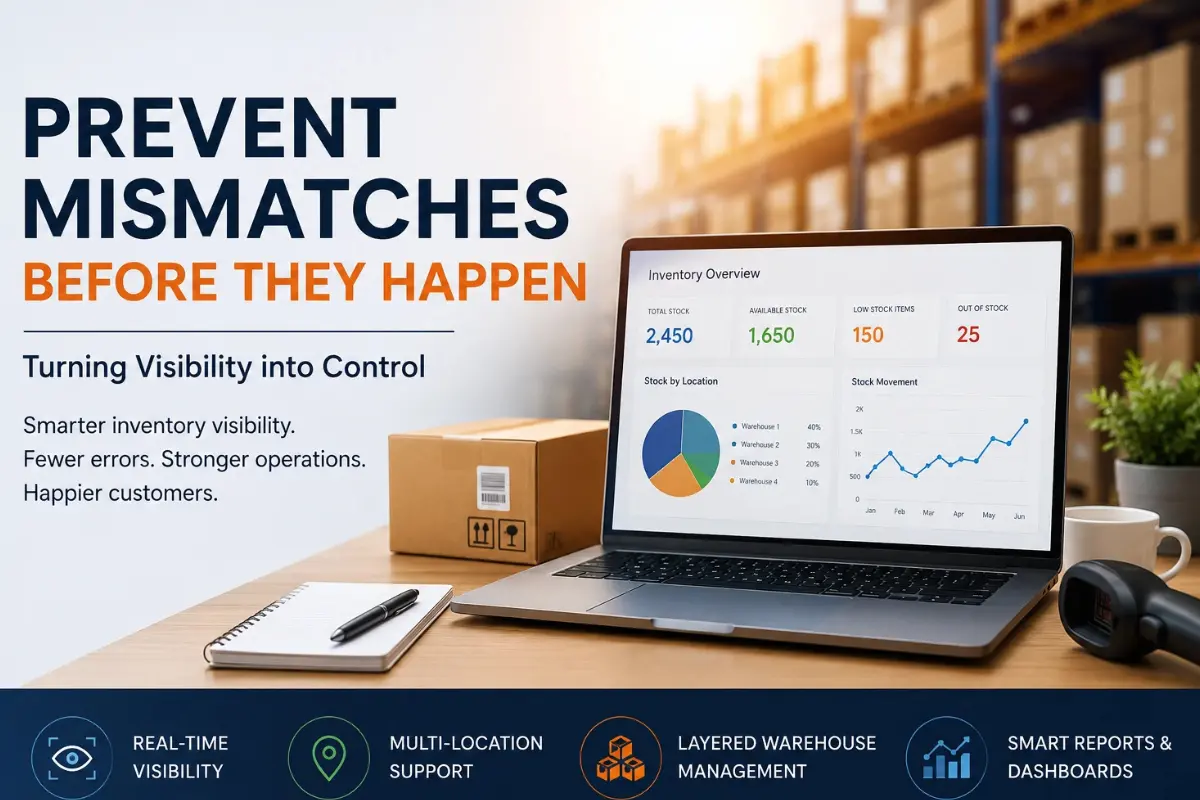
Prevent Mismatches Before They Happen
Rather than correcting inventory errors after they occur, businesses should focus on preventing them through smarter inventory management practices.
Some effective strategies include:
- Maintain real-time inventory updates across all locations.
- Centralize inventory data into a single system.
- Automate stock movement and approval workflows.
- Track inventory by warehouse, location, and product category.
- Conduct regular stock audits and cycle counts.
- Improve collaboration between sales, warehouse, and procurement teams.
- Use dashboards and reports to monitor inventory trends and stock movement.
- Implement barcode or serial number tracking wherever applicable.
These practices improve operational efficiency while reducing manual effort and human error.
Turning Visibility into Control
Organizations improve inventory management in different ways by streamlining processes, strengthening internal workflows, or adopting integrated operational platforms.
Solutions such as Ranger Fusion help businesses gain better inventory visibility through:
- Multi-location inventory management
- Layered warehouse management
- Real-time stock tracking
- Simplified stock operations
- Automated inventory workflows
- Comprehensive reports and interactive dashboards
- Better coordination between inventory, procurement, sales, and finance teams
With centralized information available across departments, businesses can make faster decisions and respond more effectively to changing customer demands.
The Business Benefits of Smarter Inventory Management
Businesses that improve inventory visibility often experience measurable operational improvements, including:
- Reduced inventory mismatches
- Faster order fulfillment
- Improved stock accuracy
- Better inventory planning
- Lower operational costs
- Reduced stock-related losses
- Higher employee productivity
- Improved customer satisfaction
- Better decision-making through real-time insights
When inventory data becomes reliable, every department benefits from greater efficiency and improved collaboration.
Future-Ready Businesses Choose Smarter Solutions
As businesses expand, inventory operations become increasingly complex. Relying on manual processes and disconnected systems makes it difficult to maintain accuracy and respond quickly to changing market demands.
Modern businesses require connected, intelligent inventory management that provides complete visibility across warehouses, teams, and business operations.
By investing in better inventory visibility today, organizations can reduce operational delays, improve decision-making, avoid costly stock-related issues, and deliver a more consistent customer experience.
With solutions like Ranger Fusion, businesses can move beyond managing inventory and begin optimizing it for long-term growth, efficiency, and operational excellence.