
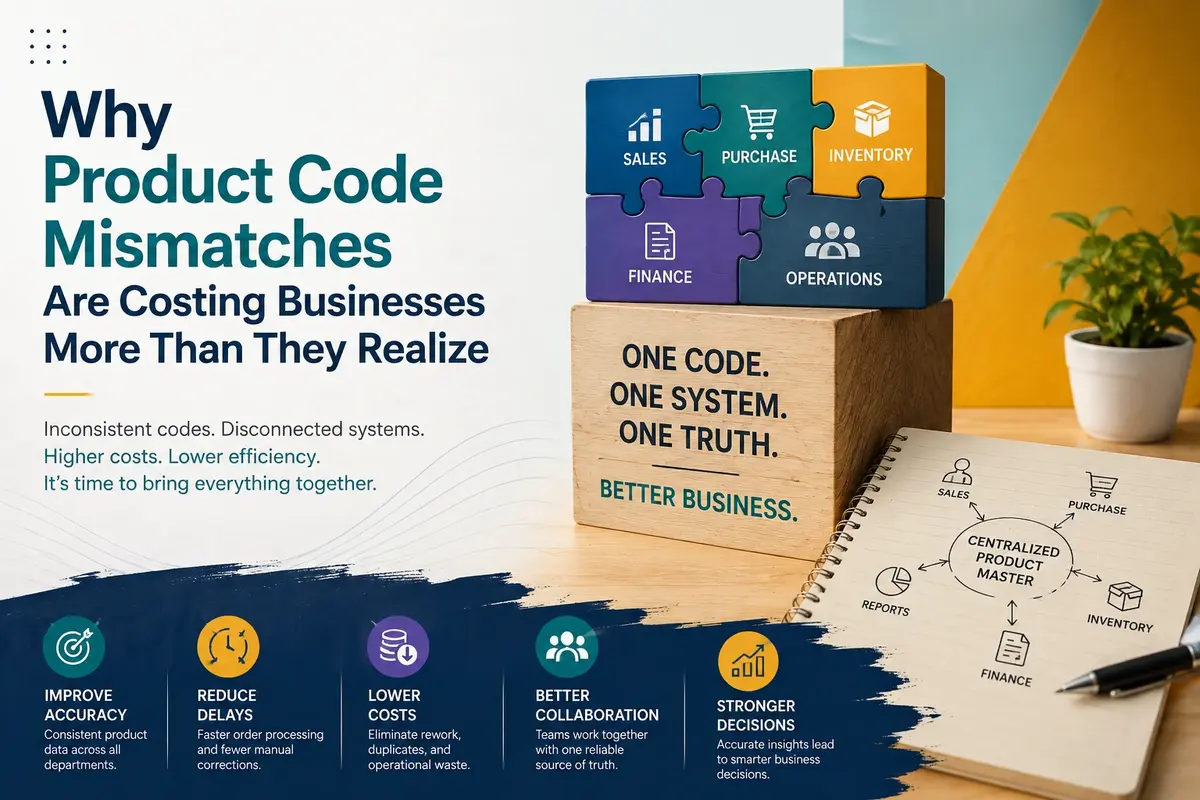
Every business relies on product information to keep its operations running smoothly. Whether it's preparing quotations, purchasing raw materials, managing inventory, generating invoices, or analyzing sales performance, accurate product data plays a vital role in every stage of the business process. Among the many elements of product data, the product code serves as one of the most important identifiers.
Although product codes may appear to be nothing more than unique labels assigned to products, they form the foundation of operational accuracy. When product codes are inconsistent across different departments or systems, businesses often experience delays, confusion, duplicate records, and costly manual corrections. These issues may not be immediately visible, but over time they accumulate and impact productivity, profitability, and customer satisfaction.
As organizations grow and transaction volumes increase, maintaining accurate product information becomes more challenging. Without a centralized system to manage product data, businesses risk creating operational bottlenecks that affect every department. Understanding the causes and consequences of product code mismatches is the first step toward building a more efficient and scalable business.
The Hidden Cost of Inconsistent Product Information
Product code mismatches rarely become noticeable until they begin disrupting everyday business activities. A product that appears under one code in the sales department may exist under a completely different code in procurement or finance. Employees may unknowingly create duplicate records simply because they cannot find the existing product in the system. Over time, the number of inconsistencies continues to grow, making it increasingly difficult to identify the correct product information.
Consider a situation where a sales executive prepares a quotation using one product reference while the warehouse processes the order using another. The finance team may generate an invoice with outdated product information, and procurement may purchase materials based on incorrect specifications. Even though each department is performing its responsibilities correctly, the lack of consistency creates unnecessary confusion throughout the organization.
What initially appears to be a small administrative issue often develops into larger operational challenges. Employees begin spending valuable time searching for the correct product, verifying details with colleagues, correcting documentation, and resolving customer complaints. Instead of improving customer relationships or expanding the business, teams become occupied with fixing avoidable errors.
The Ripple Effect Across Business Operations
Product code mismatches affect far more than product records. Since product information is shared across multiple business functions, even a single inconsistency can create a ripple effect throughout the organization.
Sales teams may accidentally quote incorrect products or pricing. Procurement teams may purchase the wrong items or reorder products that already exist in inventory. Warehouse personnel may struggle to identify products during picking and dispatch, leading to shipment delays and inventory discrepancies. Finance teams may spend additional time correcting invoices and reconciling accounts before payments can be processed.
Managers also face challenges because reports generated from inconsistent product data often fail to provide an accurate picture of business performance. Duplicate products and inconsistent coding make it difficult to analyze sales trends, evaluate inventory turnover, forecast demand, or make informed purchasing decisions. As a result, leadership teams may base strategic decisions on incomplete or inaccurate information.
These operational inefficiencies not only increase administrative costs but also reduce employee productivity and customer confidence. Customers expect businesses to process orders accurately and efficiently. Repeated errors caused by inconsistent product information can damage trust and affect long-term relationships.
Why Do Product Code Mismatches Happen?
In many organizations, product code mismatches are symptoms of disconnected business processes rather than employee mistakes. As businesses evolve, departments often adopt their own methods of managing product information. Some teams rely on spreadsheets, while others maintain separate databases or standalone software applications. Without a unified process, maintaining consistency becomes increasingly difficult.
Another common challenge is the absence of standardized naming conventions. Different employees may create products using abbreviations, alternative spellings, or supplier-specific codes. Over time, multiple versions of the same product begin appearing in the system, making it difficult to determine which record should be used.
Manual data entry further increases the likelihood of errors. Each time product information is entered into a new document, quotation, purchase order, or invoice, there is an opportunity for mistakes. Without validation rules or approval processes, incorrect information can spread quickly across departments.
As organizations expand into new locations, add more employees, or introduce additional product lines, these problems become even more difficult to manage. Businesses that continue relying on disconnected systems often find themselves spending more time managing data than managing their operations.
The Importance of a Single Source of Truth
Successful organizations understand that accurate product information is not simply an IT requirement—it is a business requirement. Rather than allowing multiple departments to maintain separate product records, they establish a centralized product master that serves as the single source of truth for the entire organization.
A centralized product database ensures that every department accesses the same information regardless of whether they are preparing quotations, processing orders, purchasing inventory, generating invoices, or analyzing reports. Changes made to product information become immediately available to authorized users, eliminating confusion and reducing the risk of duplicate records.
This approach not only improves operational efficiency but also strengthens collaboration between departments. Employees no longer need to verify product details through emails or phone calls because everyone works with the same reliable information. As a result, processes become faster, more accurate, and easier to manage.
How Ranger Fusion Solves Product Code Challenges
At Ranger Technologies, we understand that businesses need more than software—they need connected processes that eliminate unnecessary complexity. Ranger Fusion has been designed to bring together Sales, Procurement, Inventory, Finance, HR, and other critical business functions on a unified Salesforce-powered ERP platform.
Instead of maintaining product information across multiple systems, Ranger Fusion enables organizations to create products through a centralized interface where every product is managed from a single location. This significantly reduces duplicate entries while ensuring consistency across every department.
The Products module acts as the organization's centralized product master. Sales representatives, procurement teams, warehouse personnel, and finance professionals all access the same product information, eliminating confusion caused by outdated or inconsistent records.
Ranger Fusion also automates several business processes that traditionally rely on manual data entry. Once an estimation or sales order is approved, invoices can be generated automatically using the same product information, reducing the possibility of invoicing errors while improving operational speed.
Collaboration is another key strength of the platform. Through Salesforce Chatter, employees can communicate directly within Product records, Sales Orders, Purchase Orders, and other business transactions. Conversations remain attached to the relevant records, ensuring that important business discussions are never lost in lengthy email chains.
The platform also provides real-time visibility into product information. Whenever authorized users update product details, those changes become immediately available across connected business functions. This ensures that every department works with the latest information while reducing dependency on spreadsheets and manual updates.
To further improve data quality, Ranger Fusion supports configurable permissions, approval workflows, validation rules, mandatory fields, and standardized product management processes. These governance capabilities help organizations maintain accurate master data even as they continue to grow.
Business Benefits Beyond Accurate Product Codes
Eliminating product code mismatches delivers benefits that extend far beyond maintaining clean product records. Businesses often experience faster order processing because employees no longer waste time searching for or verifying product information. Invoice accuracy improves significantly, reducing payment delays and customer disputes.
Inventory management also becomes more reliable because duplicate products and incorrect stock records are minimized. Procurement teams gain greater confidence when purchasing materials, while finance departments can process transactions with fewer manual corrections.
Managers benefit from improved reporting and analytics because centralized product information produces more accurate business insights. Reliable reports support better forecasting, stronger inventory planning, and more informed strategic decisions.
Most importantly, employees spend less time correcting preventable mistakes and more time focusing on customer service, innovation, and business growth. Improved operational efficiency contributes directly to better customer experiences, increased profitability, and long-term scalability.
Product code mismatches may seem like a minor operational issue, but their effects reach every part of an organization. From sales and procurement to inventory management and finance, inconsistent product information creates unnecessary delays, increases operational costs, and limits business visibility.
As businesses continue to grow, relying on disconnected systems and manual processes becomes increasingly unsustainable. Organizations that invest in centralized product management, integrated ERP solutions, and standardized business processes are far better equipped to scale efficiently and deliver exceptional customer experiences.
Ranger Fusion helps businesses overcome these challenges by providing a unified platform that centralizes product information, automates business processes, strengthens collaboration, and improves operational visibility. By ensuring that every department works with the same accurate and reliable product data, organizations can eliminate preventable errors, improve decision-making, and build a stronger foundation for sustainable business growth.
In today's competitive business environment, success is not simply about working harder it is about creating connected systems that enable teams to work smarter, collaborate more effectively, and make confident decisions backed by accurate data.